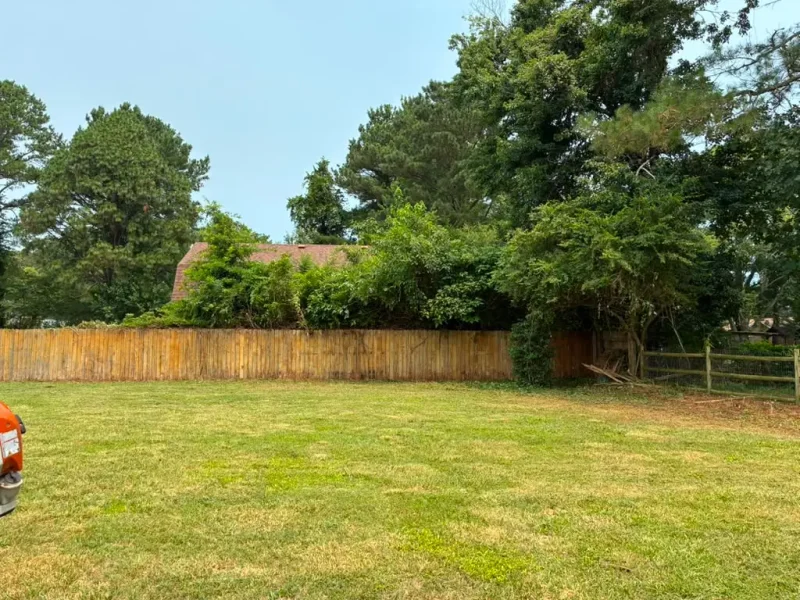
It starts with a shrub that’s a little too close to the fence. Then a season passes, and another, and before long the entire back corner of the yard is a wall of tangled vegetation that’s pressing against the wood, sending roots under the fence posts, and blocking any view of where your property actually ends. If this looks familiar, you’re not alone — overgrown fence lines are one of the most common issues we encounter in Newport News yards, and they cause more damage than most homeowners realize until the fence itself starts to show it.
Here’s what’s actually happening when vegetation takes over a fence line, what Virginia law allows you to do about it, and how to tackle it the right way.
What Overgrown Fence Line Vegetation Actually Does to Your Property
The visual problem is obvious. The structural problem is less visible but more expensive.
- Wood fences trap moisture against the fence boards when dense shrubs and vines grow directly against them, blocking airflow and keeping the wood perpetually damp. That’s the exact condition that accelerates rot, mold, and fungal decay in wood fencing — cutting years off the fence’s useful life
- Roots from overgrown shrubs and trees grow under and around fence posts, lifting them out of alignment and undermining the structural integrity of the entire fence line over time
- Heavy branches leaning against or over the fence add weight and wind load that wood fences aren’t designed to carry, especially during Hampton Roads storm season when canopy-heavy trees become a significant liability
- Dense vegetation along the fence line creates a pest corridor — exactly the kind of shaded, humid, undisturbed environment that ticks, mosquitoes, and rodents use to move across a property undetected
None of these problems fix themselves. They compound each season the vegetation is left in place.
What Virginia Law Allows You to Do
Before taking any action on fence line vegetation — especially when trees or shrubs are near or crossing a property line — it helps to understand what Virginia law actually permits.
Virginia follows the self-help doctrine established in the 2007 Virginia Supreme Court case Fancher v. Fagella. In practical terms for Newport News homeowners, this means:
- You have the legal right to trim any branches or roots that encroach onto your property, up to the property line, at your own expense — regardless of where the tree or shrub originated
- You must not kill or seriously damage the tree or shrub in doing so — the right to trim stops at the property line and does not extend to harming the plant itself
- If encroaching branches or roots cause actual damage to your property — to a fence, a structure, a foundation, or underground utilities — you may have grounds for a nuisance claim against the neighboring property owner
- Dropped leaves, shade, or fruit alone do not constitute a nuisance under Virginia law — actual structural damage or a clear hazard is the threshold
For vegetation growing entirely on your own property, you have full authority to trim, shape, or remove it without any legal constraint beyond any local permit requirements that may apply for tree removal.
How to Actually Clear an Overgrown Fence Line
The approach depends on how long the vegetation has been growing unchecked and how close it is to the fence structure itself.
Step One: Assess Before You Cut
Walk the fence line and identify what’s growing. Vines climbing the fence boards need to come off first — they’re the most immediately damaging to wood surfaces. Shrubs that have grown into or against the fence need to be cut back before any root work happens. Trees with branches resting on or overhanging the fence need to be evaluated for whether trimming is sufficient or whether removal is the better long-term answer.
Step Two: Remove Vines First
Vines are deceptive — they look manageable but their root systems are often more established than the above-ground growth suggests, and pulling them directly off fence boards can tear the wood surface. Cut them at the base first and let them dry out before attempting to pull them free from the fence. Trying to rip live, rooted vines off a wood fence is one of the fastest ways to damage the boards you’re trying to protect.
Step Three: Cut Back Shrubs to a Maintainable Size
For shrubs that have grown into the fence line, the goal is to establish a clear gap — ideally at least one to two feet — between the outermost branches and the fence surface. This allows air to circulate, the wood to dry after rain, and gives you a maintainable boundary going forward. For heavily overgrown shrubs, this may need to be done gradually over two to three seasons using the rejuvenation pruning approach rather than cutting everything back at once.
Step Four: Address the Root Zone
Once above-ground growth is cut back, root systems that have grown under fence posts or into the fence line need to be addressed — otherwise the same problem resurfaces faster than the visible growth would suggest. Surface roots along the fence line can be cut at the property boundary, but removing established root systems close to fence posts requires care to avoid further destabilizing the posts themselves.
Step Five: Establish a Maintenance Routine
A cleared fence line doesn’t stay cleared without regular attention, particularly in Hampton Roads where Virginia’s long growing season means vegetation that’s trimmed in spring can be pressing against the fence again by fall. A consistent shrub trimming and fence line maintenance schedule is what prevents a one-time clearing project from becoming a recurring overhaul every few years.
When the Situation Calls for Professional Help
Fence line clearing that involves large shrubs, established trees, root systems near fence posts, or vegetation crossing a property line isn’t a straightforward DIY project — particularly when there are structural, legal, or neighbor relations dimensions to consider. Working near a fence also requires care to avoid damaging the structure while removing what’s threatening it.
B. Meister Landscaping handles shrub trimming and fence line clearing throughout Newport News and the surrounding Hampton Roads area. We assess what’s there, determine the right approach for the plants and the fence structure involved, and clear the line in a way that gives you back control of your property boundary.
📞 Contact us today for a free estimate and let’s get your fence line cleared before the next growing season adds another layer to the problem.