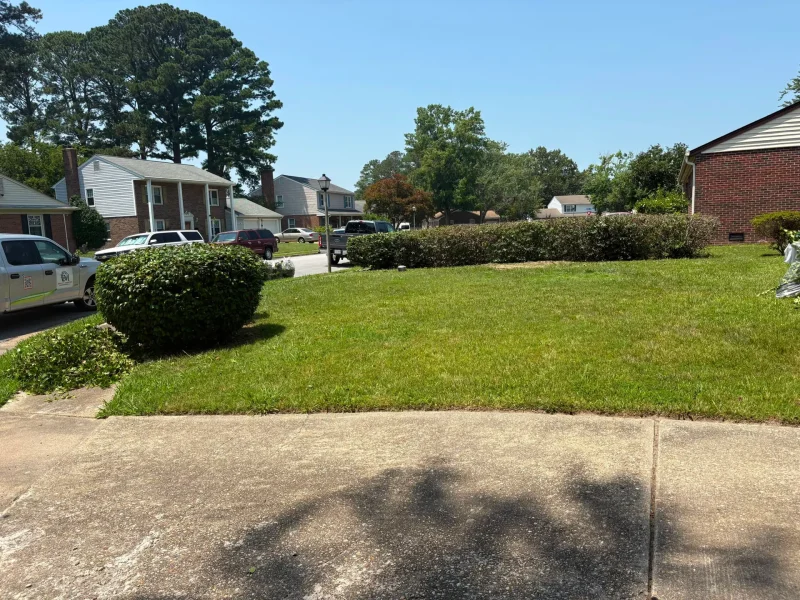
Most of us think about curb appeal one house at a time: our lawn, our shrubs, our front walk. But when someone drives down your street, whether it’s a neighbor, a delivery driver, or a buyer touring the area, they don’t judge each yard separately. They take in the whole street at once, and the overall impression is made up of every yard on it.
That is why the yard next door matters to you, and why yours matters to the people next door. Here is how a shared street works as a single picture, what “consistent” actually means, and how to keep your own yard in step with the neighborhood without making it look cookie-cutter.
Why the Street Is Judged as One Picture
Buyers evaluate the neighborhood, not just the house. When they pull onto a street, the first things they notice are the homes and the yards. If most properties are tidy, with trimmed shrubs, mowed lawns, and no visible clutter, the whole block feels well cared for. That collective effect creates a desirable streetscape and supports the value of every home on it.
The reverse is just as true. One neglected property can change how an entire street reads.
The numbers show how much people notice. In a survey of more than 1,000 homeowners by NaturaLawn of America, 95% said a neighbor’s lawn influences their first impression of a home, and 93% believed a poorly maintained neighboring yard signals lower home values. More than half, 56%, said they would hesitate to buy a home next to a poorly maintained lawn.
Industry estimates of the financial effect vary widely, and no single figure applies to every street. Appraisers recognize the concept, though. A neglected neighboring property is a form of “external obsolescence,” meaning a loss in value caused by something outside the owner’s control. Estimates commonly cited for a poorly maintained neighboring home run from about 5% to 10%, with higher figures for vacant or foreclosed properties.
You can’t control the yard next door, but you can control yours, and that is the part that counts toward the shared picture.
What “Consistent” Actually Means
Consistency doesn’t mean every yard looks identical. It means each yard meets the same basic standard of care, so no property looks out of place. On most Newport News streets, that standard comes down to a handful of visible details.
- Lawn Height and Mowing Rhythm
A lawn cut regularly at a consistent height looks intentional. A yard mowed every two or three weeks while the rest of the street is on a weekly schedule shows up immediately, because the height difference is visible from the road. During Hampton Roads’ long growing season, the gap between a mowed lawn and a lagging one widens quickly.
Clean lines along the sidewalk, driveway, and bed borders make a yard read as finished. Edges blur quickly in a humid climate where grass spreads into hard surfaces. On a street where most yards are edged, an unedged one looks neglected even if the lawn itself is fine.
Overgrown shrubs are among the most visible inconsistencies on a street, especially in established neighborhoods with foundation plantings and hedge lines. Trimmed shrubs along the front of a home signal care, and they affect how the whole house looks next to its neighbors.
- Debris, Bins, and Clutter
Visible trash, stacked debris, and trimmings left at the curb draw attention fast. A neat yard with clutter beside it still looks untidy. Keeping bins out of sight, clearing clippings promptly, and avoiding long-term storage in the front yard all help.
Weeds in cracks, stains, and overgrowth creeping onto the walk show up in the same sweep of the eye as the lawn does. Hardscape surfaces are part of the yard.
Matching the Street Without Losing Your Own Style
Consistency doesn’t require giving up personality. Choosing your own plants, mulch color, or planters is fine. What matters is the underlying upkeep.
A useful rule is to match the street on maintenance level and stay flexible on design. Your yard can look different from your neighbor’s as long as it looks equally cared for. Bold design choices tend to cause friction mainly when they come with neglect, or when they clash sharply with the character of a street full of established homes.
In many Newport News neighborhoods, the character is mature trees, brick or siding homes, and traditional foundation plantings. Staying close to that look in scale and upkeep helps a yard fit in naturally.
If You Live in an HOA
Many communities have written landscaping standards, and they exist for exactly the reason above. Requirements to keep lawns mowed and landscaping maintained protect curb appeal, which is directly tied to property values, so one owner’s lapse affects everyone else’s home.
If you’re in an HOA, read the covenants before starting a project. Rules often cover lawn upkeep, plant removal, fence and structure changes, storage in front yards, and parking on grass. If you receive a notice, respond quickly. Most violations involve simple maintenance issues that a clean-up and a trim can resolve before fines build up.
If a Neighbor’s Yard Is Dragging Down the Street
It’s frustrating to maintain your yard well while the one next door slips. A few practical points:
- Start with a friendly conversation. Many yards decline because of illness, travel, age, or time, not indifference. A polite word often works better than a complaint.
- Know the difference between unattractive and a violation. You generally can’t force a neighbor to upgrade a yard that is merely unattractive. If conditions break a local property maintenance ordinance or HOA rule, or create a safety issue, the appropriate route is the HOA or city code enforcement, not a confrontation.
- Strengthen the side of your property that faces them. Defined edges, fresh mulch, tidy shrubs, and a clean boundary line make your own yard look intentional regardless of what’s next door.
Keep It Consistent All Season
Street-level consistency is a seasonal job. Hampton Roads’ long growing season, fall leaf drop, and storm debris all work against it. A yard that looks right in June can fall behind by October if the upkeep slips, and the gap is visible from the road. A regular maintenance schedule keeps your yard at the same standard through every season, not only after a one-time clean-up.
Let B. Meister Keep Your Yard in Step With Your Street
Consistent curb appeal comes from regular mowing, defined edges, trimmed shrubs, and prompt clean up. B. Meister Landscaping provides yard maintenance, shrub trimming, and clean up throughout Newport News and the surrounding Hampton Roads area, for homeowners who want their yard to hold its own on a shared street.
📞 Contact us today for a free estimate, and let’s make sure your yard is helping your street’s curb appeal, not working against it.