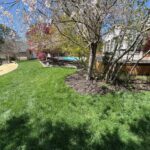
It happens gradually in almost every Newport News yard — a shrub that was manageable a few seasons ago has turned into a tangled mass of crossing trunks, dead interior branches, and sprawling growth that’s pushing against the fence, touching the siding, or simply taking over the bed it was planted in. The instinct for most homeowners is either to ignore it or cut it back as hard as possible to get it under control fast.
Both approaches tend to backfire. Ignoring it lets the problem compound each season. Cutting too aggressively shocks the plant and can trigger the exact decline you were trying to avoid. The good news is that most overgrown multi-trunk shrubs — even badly neglected ones — can be brought back under control without killing them, as long as the work is done in the right sequence and at the right time.
Why Multi-Trunk Shrubs Get Out of Control
Multi-stemmed shrubs — viburnums, forsythias, loropetalums, native dogwoods, and many others common in Hampton Roads yards — grow from the base rather than from a single central trunk. That growth habit is what makes them vigorous and full, but it’s also what allows them to get dramatically overgrown when left untrimmed for multiple seasons.
Virginia’s heat, humidity, clay-rich soil, and long growing season accelerate the pace at which shrubs push new growth — meaning a shrub that might stay manageable for three to four seasons in a drier climate can exceed its space in half that time in Newport News. By the time most homeowners address it, there are multiple thick, woody trunks at the base, dead material in the interior, and the plant has likely lost most of its natural shape.
The Most Important Rule Before You Cut Anything
In general, don’t prune away more than one-third of a shrub’s growth during its active growing season — cutting back more than that can shock the plant and put it at serious risk. This is the baseline limit that applies to surface shaping, but overgrown multi-trunk shrubs require a different approach entirely: rejuvenation pruning, which works from the base rather than the surface.
The key distinction is that rejuvenation pruning targets the oldest, thickest trunks at ground level rather than trimming the outer canopy. Trimming only the top and sides of a badly overgrown shrub makes the situation worse over time — trimming just the outer surface encourages the plant to grow even leggier and taller without addressing what’s happening at the base. The real reset happens at the roots.
Two Approaches: Gradual Renewal vs. Hard Rejuvenation
Depending on how overgrown the shrub is and how quickly you need results, there are two methods that work for multi-trunk shrubs in Virginia.
Gradual Renewal (Recommended for Most Cases)
This is the safer method and produces the most natural-looking results. Begin by removing one-third of the largest, oldest stems at ground level in late winter or early spring — March or early April in Virginia. The following year, prune out one-half of the remaining old stems and thin out some of the new growth, retaining several well-spaced, vigorous shoots. By the third year, remove any remaining old wood.
This multi-year approach is often the safest route — removing roughly a third of the oldest stems at ground level each dormant season while keeping younger, vigorous stems active. The shrub stays functional and reasonably attractive through the entire process rather than leaving it looking like a stump for a full season.
Hard Rejuvenation (For Severely Neglected Shrubs)
For multi-trunk shrubs that are so far gone that gradual renewal isn’t practical, a more aggressive reset is an option — but only for species that are known to resprout from old wood. Deciduous shrubs with multiple stems that have become very overgrown can be rejuvenated by cutting all canes back as close to the ground as possible in early spring. That season’s flowers may be sacrificed, but the benefits of bringing the plants back to their normal size and shape outweigh this temporary setback.
This technique works best for shrubs such as overgrown spirea, forsythia, cane-growth viburnums, honeysuckle, and other multiple-stemmed shrubs that are otherwise healthy. The plant will look stark immediately after the cuts but typically pushes vigorous new growth within weeks once spring temperatures arrive.
Where and How to Make the Cuts
Knowing where to cut matters as much as how much to remove.
- Cut oldest trunks at or near ground level, not partway up the stem — a partial cut on an old trunk leaves a stub that rarely produces useful new growth and can become an entry point for disease
- Use the right tool for the size of the stem — hand pruners for stems under three-quarters of an inch, loppers for anything up to two inches, and a pruning saw for the thickest trunks; dull tools crush tissue rather than cutting cleanly, which matters in Virginia’s humid climate where cut surfaces are vulnerable to fungal entry
- Cut just above an outward-facing bud when shortening stems rather than removing them entirely — this directs new growth outward rather than back into the center of the plant
- Sterilize pruning equipment between cuts when disease is present — use a mixture of one-third bleach to two-thirds water, then thoroughly rinse and dry tools before continuing to avoid damaging healthy tissue
Timing It Right for Hampton Roads
Badly overgrown shrubs respond best to pruning in late winter and early spring, just before new leaves appear. In Newport News, that window typically falls between late February and early April depending on the species and the season’s weather patterns.
For flowering shrubs, timing gets more specific. Shrubs that bloom on old wood — like azaleas and camellias — set their flower buds the previous season, so hard pruning before bloom removes the display entirely. For these, prune immediately after bloom ends. For shrubs that bloom on new wood, late winter pruning is fine since the season’s new growth will carry the flowers anyway.
Summer pruning in Virginia’s humid climate plays a different role — it’s useful for managing disease pressure and opening up airflow, but the major structural work on overgrown plants should still happen in that late winter or early spring window.
An Alternative: Train It Into a Small Tree
If a multi-trunk shrub has grown so large that even rejuvenation pruning won’t bring it back to a reasonable size for the space, there’s another option worth considering. Remove all stems except the strongest and most upright one, then remove the lower branches on that remaining stem to create a defined trunk and canopy. This works particularly well when most of the lower branches are already in poor condition — the result is a small specimen tree that fits the space with a clean, intentional look rather than the dense, sprawling form of an overgrown shrub.
When It’s a Job for a Professional
Identifying which stems to keep, which species tolerate hard cuts, and how to sequence the work to protect the plant’s health through Hampton Roads humidity and heat — these are the details that separate a shrub that comes back stronger from one that declines after aggressive pruning. While minor trimming is manageable for most homeowners, professional pruning makes a significant difference for larger shrubs or species with specific needs, especially in Virginia’s demanding climate.
B. Meister Landscaping provides professional shrub trimming throughout Newport News and the surrounding Hampton Roads area. Whether it’s a single overgrown multi-trunk specimen or an entire property’s worth of neglected beds, we assess each plant individually and prune in a way that restores shape without setting the plant back.
📞 Contact us today for a free estimate and let’s get your shrubs back under control before the next growing season gets ahead of you.