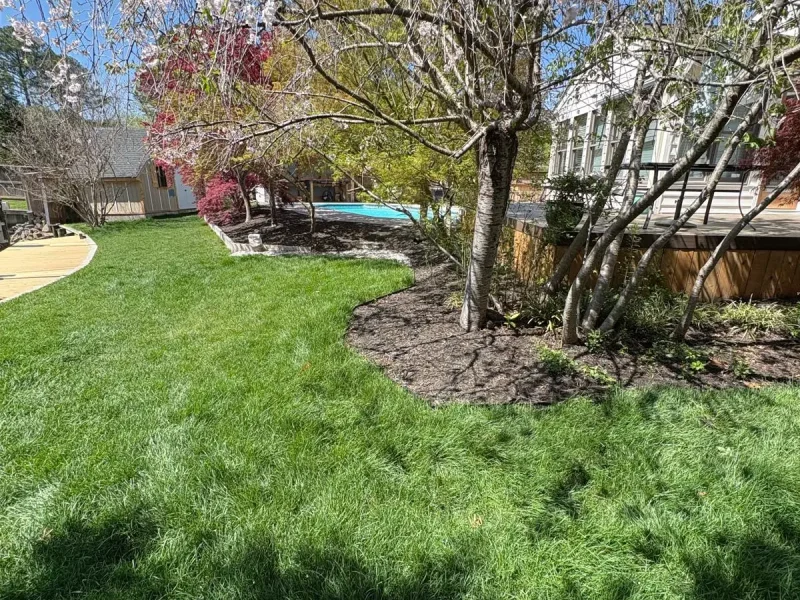
Mulching around trees is one of the most beneficial things a Newport News homeowner can do for their landscape. Done correctly, it protects roots, retains moisture through Virginia’s dry spells, suppresses weeds, and gives beds a clean, professional appearance. Done incorrectly — which is unfortunately how most residential trees in Hampton Roads are mulched — it slowly damages the very trees it’s meant to protect.
The difference between right and wrong comes down to a few specific details that most homeowners don’t know until something goes wrong.
Why Tree Mulching Matters More in Hampton Roads
Hampton Roads’ climate creates specific conditions that make mulching both more beneficial and more consequential than it would be in a drier or cooler region.
Virginia’s long growing season, summer heat, and periods of drought stress tree root systems that are often already compromised by compacted clay soil. Mulch acts as a buffer — it moderates soil temperature, slows moisture evaporation, and reduces the compaction that limits how deep and wide roots can grow. At the same time, Hampton Roads’ high humidity means that mulch applied incorrectly traps moisture in places it shouldn’t be, creating the warm, wet conditions that invite fungal disease, bark decay, and root rot — problems that develop quietly and become expensive to address once they’ve progressed.
Getting the technique right matters here more than it would in a climate that naturally stays drier or cooler.
The Donut, Not the Volcano
The single most important concept in tree mulching is the shape: the correct form is a flat donut, not a mound.
A mulch volcano — where mulch is piled up against the trunk in a cone or mound — is the most common mistake in residential landscapes and one of the most damaging. Bark decay occurs when mulch is left against tree trunks for extended periods, and the trunk of a tree is not designed to be in contact with decomposing organic material. That constant moisture contact softens and breaks down bark, creates entry points for disease and insects, and can eventually girdle the tree — cutting off the flow of water and nutrients between roots and canopy. Mulch volcanoes are easy to spot in any Newport News neighborhood, and most homeowners who have them don’t realize the damage being done beneath the surface.
The correct method keeps mulch pulled back from the trunk entirely, spread flat across the surrounding soil in a ring — a donut shape with the trunk at the center of an empty hole.
The Numbers That Matter
Depth: 2 to 3 inches. This is the target range for most trees. Fine-textured mulches like shredded hardwood should stay at the lower end of that range — around 2 to 3 inches — while coarser materials like wood chips or bark nuggets can go up to 4 inches. Below 2 inches, mulch doesn’t retain enough moisture or suppress weeds effectively. Above 4 inches, it blocks oxygen exchange at the soil surface and keeps the root zone too wet, which is particularly problematic in Hampton Roads’ already-humid conditions.
Adding new mulch on top of old without measuring first is one of the most common ways a yard gradually develops volcano mulching — one inch per year adds up fast over several seasons.
Clearance from the trunk: 3 to 6 inches minimum. For young trees, keep mulch at least 3 inches from the trunk. For established mature trees, that clearance should be 8 to 12 inches. The root flare — where the trunk visibly widens as it meets the root system — must stay fully exposed above the mulch line at all times.
Ring width: at least 3 feet from the trunk, ideally to the drip line. The drip line is the circle on the ground directly beneath the outermost edge of the branches, and it roughly marks where the feeder roots are most active. Mulching out to the drip line on younger trees, and at least 3 to 6 feet from the trunk on established trees, gives roots the protected, biologically active soil zone they need. The larger the mulched area, the more beneficial the application.
The Right Mulch Material for Virginia Trees
Organic mulch is the correct choice for tree rings in Hampton Roads. Wood chips, shredded hardwood, and bark mulch all decompose over time, feeding soil microbes and gradually improving soil structure — particularly important in Newport News where compacted clay soil limits root development. This decomposition process is part of how mulch benefits trees beyond just moisture retention.
Inorganic materials like decorative rock or rubber mulch don’t decompose, so they don’t improve soil over time. They also trap heat at the soil surface, which compounds summer stress on tree roots in Virginia’s already-hot summers. Rock mulch in particular can raise soil temperatures significantly in direct sun, creating conditions that damage the shallow feeder roots it’s meant to protect.
For trees in shaded or partially shaded beds — common in established Newport News neighborhoods with mature canopy — darker mulch like triple-ground hardwood retains a clean appearance longer and complements the look of ornamental trees through spring and summer.
One Thing Most Homeowners Miss: Check the Root Flare
Before adding any new mulch, check whether the root flare is visible. The root flare is the point at the base of the trunk where it visibly widens as it transitions to the root system — it should be visible above the soil line at all times.
If the trunk appears to go straight into the ground like a post with no visible flare or widening, the root flare is buried — either from previous mulch applications, soil settling, or how the tree was originally planted. Buried root flares restrict the tree’s ability to exchange oxygen and can lead to girdling roots that eventually cut off circulation. If the flare is buried more than a few inches, correcting it before adding new mulch is the priority.
How Often to Refresh Tree Mulch in Hampton Roads
Hampton Roads’ heat and humidity accelerate mulch decomposition compared to drier climates. Check mulch depth annually and refresh when it drops below 2 inches or fades significantly in color. For most Newport News yards, this means a fresh application every one to two years rather than every three to four as might be appropriate in cooler regions.
When refreshing, always measure existing depth first. If the existing layer is still within range, a light top-up is enough. If old mulch has become compacted, rake it loose before adding new material rather than simply adding on top of a dense, matted layer that has stopped functioning properly.
Let B. Meister Handle It the Right Way
Mulch installation looks simple, but the details — depth, clearance, ring width, material selection, and root flare exposure — make the difference between mulch that protects your trees and mulch that quietly damages them over several seasons. B. Meister Landscaping provides professional mulch installation throughout Newport News and the surrounding Hampton Roads area, applied correctly around every tree and bed on the property.
📞 Contact us today for a free estimate and let’s get your trees the protection they need before the next growing season.