An above-ground pool is one of the most practical investments a Newport News homeowner can make for their backyard — but without any hardscaping around it, the area quickly becomes a muddy, grass-worn ring that tracks dirt into the water every time someone climbs in. The good news is that transforming a plain pool surround into something that looks intentional and functions well doesn’t require a major investment. Some of the most effective pool area hardscaping in Hampton Roads backyards is also some of the most straightforward.
Here’s what actually works, what to avoid, and how to get the most out of a realistic budget.
Why Pool Areas Need Hardscaping in the First Place
Before getting into specific ideas, it’s worth understanding what’s actually happening without hardscaping in place. In Newport News, where summer humidity and frequent rain are constants, a bare soil or grass pool surround doesn’t last. Foot traffic, splash water, and poolside activity wear away grass faster than it can recover, leaving exposed soil that turns to mud after rain and gets tracked directly into the pool. That mud and debris shortens filter life and increases maintenance demands over the entire season.
Hardscaping around the pool replaces that problem zone with a stable, drainable surface that stays clean, handles moisture properly, and requires far less upkeep than grass or bare ground. It also gives the pool area a defined, finished look rather than the afterthought appearance that a plain above-ground pool can have in an otherwise maintained yard.
The Most Budget-Friendly Option: Gravel With Edging
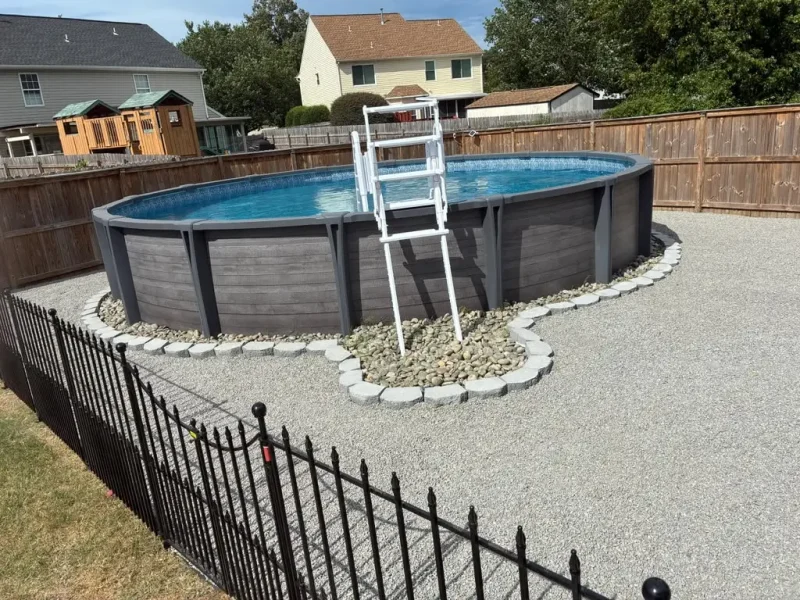
Pea gravel over landscape fabric is the most cost-effective pool surround solution that actually performs well in Hampton Roads conditions. It drains splash water immediately rather than pooling, stays cooler underfoot than bare concrete or pavers in direct sun, and suppresses weeds effectively when installed over quality landscape fabric. A clean edging border — concrete pavers, natural stone, or aluminum landscape edging — keeps the gravel contained and gives the surround a defined, polished look that reads as intentional rather than utilitarian.
A few things to keep in mind with gravel:
- Leave a gap between the gravel and the pool wall itself — allowing at least a few inches of clearance prevents moisture from sitting directly against the pool structure and helps airflow around the base
- Choose rounded pea gravel or river rock over crushed angular stone for a pool surround — angular gravel is uncomfortable underfoot and can scratch pool liners if tracked into the water
- Landscape fabric underneath is non-negotiable in Virginia’s growing conditions — without it, weeds push through gravel quickly and the entire surround needs to be redone within a season or two
The combination of landscape fabric, pea gravel, and a clean edging border is one of the most common pool surround approaches we install in Newport News yards, and it holds up well through Hampton Roads summers.
Adding Pavers for Walkways and Entry Points
Gravel alone works well as a surround, but adding a defined paver walkway from the gate or back door to the pool ladder creates both function and visual structure. It gives wet feet a stable, non-slip path and keeps the highest-traffic area — where people walk back and forth most frequently — from compacting the gravel over time.
Simple concrete pavers are the most budget-conscious option and are widely available in formats that complement almost any backyard style. Natural stone pavers cost more but add a finished look that holds up particularly well aesthetically over time. Either can be set directly into a gravel surround or on a compacted sand base, and both are straightforward for a professional crew to install quickly.
A variation that works well in larger pool surrounds is mixing pavers and gravel — pavers at the entry point and along the highest-traffic path, with gravel filling the remainder of the surround. The pavers handle the wear where it matters most, while gravel covers the larger area at a lower material cost.
Decorative Rock and River Stone as Accent Features
The image on this post shows exactly how effective a small accent bed of river rock can be at the base of a pool ladder or entry point. That transition zone — where wet feet first land after climbing out of the pool — benefits from a slightly different surface treatment than the broader surround: larger, rounder river rock provides drainage while creating a distinct visual moment that breaks up a uniform gravel field.
Decorative rock accents bordered by concrete edging blocks are one of the lowest-cost ways to add visual depth to a pool surround without increasing the overall project scope significantly. They also serve a practical function, marking the entry and exit point clearly and providing a surface that handles concentrated splash water well.
Fencing: Safety and Visual Definition
A well-chosen fence around the pool area does two things simultaneously — it meets safety requirements for pool enclosures and defines the hardscaped zone as a distinct outdoor space within the broader yard. In Newport News, where residential lots often have existing wood privacy fencing, adding a secondary wrought iron or aluminum pool fence inside that perimeter creates a layered look that separates the pool area from the rest of the yard without blocking views or light.
Wrought iron and aluminum pool fencing are both durable choices in Hampton Roads’ coastal humidity — unlike wood, they don’t absorb moisture or require the same maintenance schedule that a wood fence near a pool would demand.
What to Avoid Around a Pool in Hampton Roads
A few common choices that seem appealing but create problems in Virginia’s climate:
- Mulch directly against the pool wall — mulch holds moisture against the pool structure and breaks down faster in Hampton Roads humidity than it would in a drier climate; keep mulch at least a foot back from the pool if used as part of a surrounding bed
- Grass as the primary pool surround — foot traffic and splash water will eliminate it within a season; it’s not a viable long-term surface for the immediate pool perimeter
- Fine sand without containment — tracked into the pool, sand is abrasive to liners and hard on filtration equipment; if sand is used, solid edging on all sides is essential
- Dense plantings directly against the pool — plants that drop leaves, seeds, or flowers near the water increase cleaning demands significantly; keep plantings at the outer edge of the hardscaped area rather than immediately adjacent to the pool wall
What a Pool Area Hardscaping Project Actually Costs in Newport News
Budget pool area hardscaping doesn’t mean low quality — it means choosing materials and a layout that deliver maximum visual and functional impact per dollar spent. A gravel surround with landscape fabric, clean edging, and a paver entry path covers the core needs effectively and can be completed for a fraction of what a full custom patio project costs. Decorative rock accents and pool fencing can be added as the budget allows, either in the initial project or as additions in a subsequent season.
B. Meister Landscaping designs and installs pool area hardscaping throughout Newport News and the surrounding Hampton Roads area — from simple gravel surrounds with edging to more complete outdoor living spaces that incorporate pavers, fencing, and planting areas.
📞 Contact us today for a free estimate and let’s design a pool surround that works for your yard and your budget.